A boundless domain of culture?

Debates and the digital humanities
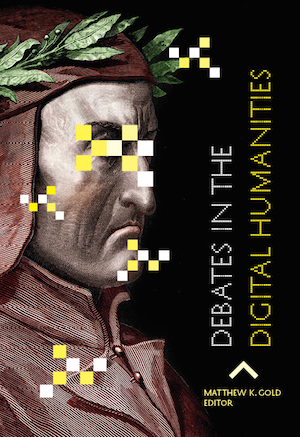
debatessmallThere has been a flurry of debates recently surrounding the digital humanities, sparked in part by the publication of Matthew Gold’s volume, Debates in the Digital Humanities, and Stanley Fish’s extended responses in the New York Times. Annual conferences for both the Modern Language Association and the American Historical Association featured numerous roundtables and panels concerning the humanities computing, digital pedagogy and electronic infrastructures for scholarly work. The text based scholarship so vital to the work of the humanities (and its related infrastructure) is both complicated and broadened by digital technologies and the digital humanities has emerged front and center proclaiming its suitability as the discipline best positioned to explore a post-Gutenberg galaxy.

Nearly sixty sessions at this year’s MLA had a digital humanities connection (see Mark Sample’s post).  During a session on Literary Research in/and Digital Humanities convened by James R. Kelly,  a Humanities Bibliographer at the University of Massachusetts Amherst, Heather Bolwby discussed some of the factors involved in successfully launching Julia Margaret Cameron’s photographic illustrations to Tennyson’s Idylls of the King as a digital resource. In her presentation, Bowlby pointed out some of the considerations she had to take into account with the project,  including locating the necessary technical support, determining how the resource would  function within different scholarly contexts, securing an enduring online space to house the resource, and collaborating with librarians and other professionals in related fields to fit the resource within pre-existing institutional frameworks.
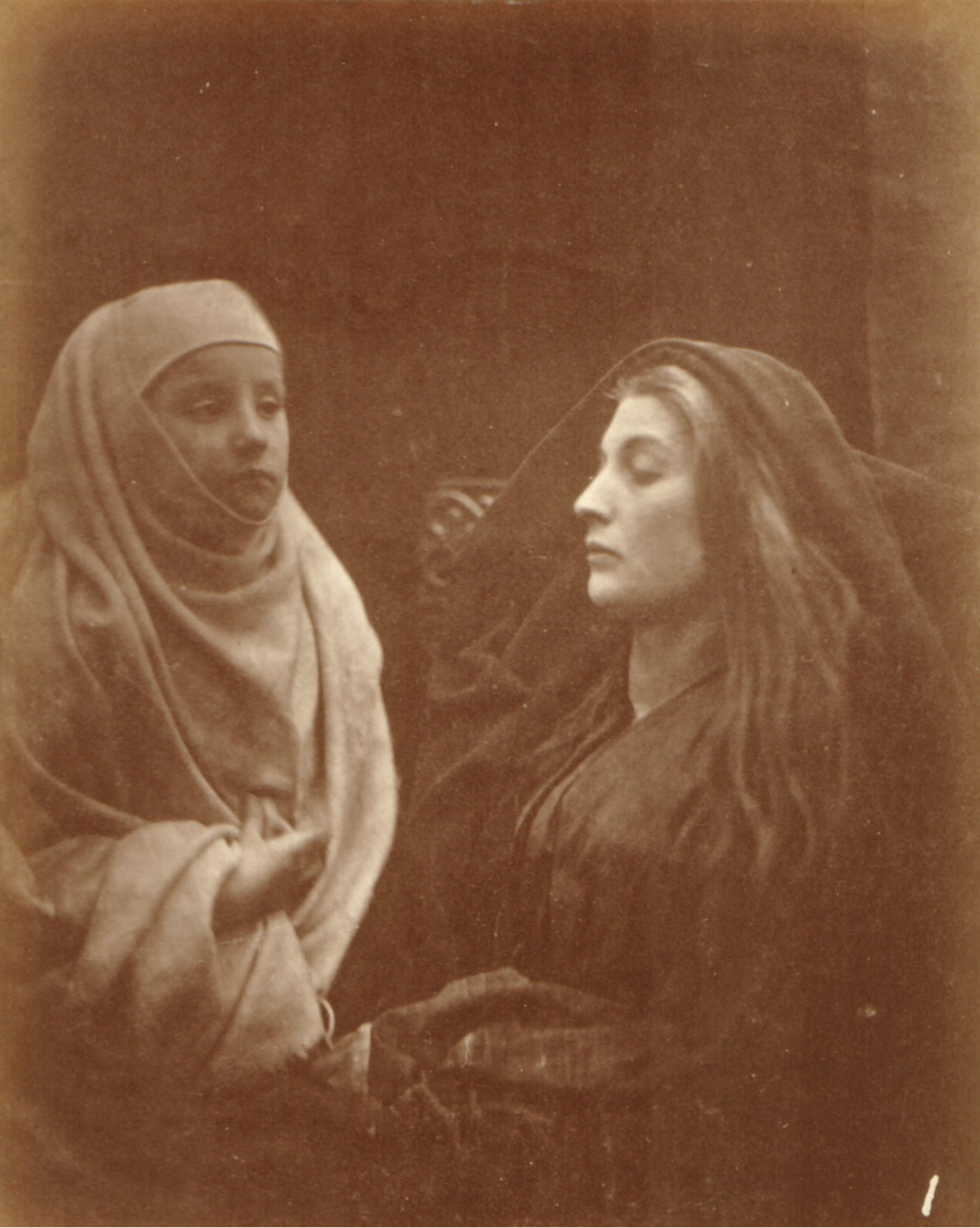
So the stately Queen abode
For many a week, unknown, among the nuns;
Nor with them mix’d, nor told her name, nor sought,
Wrapt in her grief, for housel or for shrift,
But communed only with the little maid,
Who pleased her with a babbling heedlessness
Which often lured her from herself.
(Idylls of the King, Book XI – l. 144-150)


[Julia Margaret Cameron, ‘The Little Novice and the Queen’, plate XI from The Idylls of the King, albumen print 1874]

Bowlby’s project aimed at the reproduction of the physical object as much as possible in an electronic format while maintaining the appropriate scholarly framework. Yet reproduction, as anthropologist Marilyn Strathern reminds us, involves two processes. The first, is the process of replication, when the original material is duplicated. The second process is one of expression, when the replication of the original material takes shape within a new context.  Bowlby presented her efforts as “case study of the problems facing graduate students involved in similar digital projects.”

The digital duplication of the physical object, whether it be a rare photograph, a manuscript or a scholarly monograph, no longer poses difficulty, but the process of its expression and its context is at the crux of many of the debates surrounding digital humanities today. What form will that expression take? Will it conform to current (and future?) standards for preservation and sustainability? And what is the appropriate context for that expression? Will it ensure its continued expression over time? Will it allow the expression to be accessible to many or to a select few? Will the context overwhelm the expression? And will that context be re-iterated or aggregated in other contexts? If so, how? Just as the potential for duplication is seemingly endless in a digital context, so too is the potential for expression and for an infinity of contexts within this boundless domain.

Pioneering photographer Julia Margaret Cameron was particularly sensitive to questions of reproduction and expression in her photographs for Tennyson’s work. Using a new and challenging medium such as photography in such unique ways for the time, Cameron’s illustrations deliberately imitated the oil paintings in the style of the contemporary Pre-Raphaelite painters.  Why? As she explained simply, “my aspirations are to ennoble Photography and to secure for it the character and uses of High Art by combining the real and ideal sacrificing nothing of Truth by all possible devotion to Poetry and beauty.” Her project to “ennoble photography” is similar to the project of many digital humanists today: to ennoble their field as one worthy of expression and of context. What must the digital humanities find then to secure for it “the character and uses” of a discipline or a scholarly presence within a boundless domain of culture?

cross posted at HASTAC
Digital History 2.0

The title of this blog is intentionally oxymoronic. Digital History stands for the fresh, the new, the innovative; Yale is a byword for the venerable, the traditional, and the conservative. The two terms exist in an awkward tension. I have always thought that if the digital humanities – as a methodology, as a practice, as a discipline – could thrive at a place like Yale, they could thrive anywhere. As an arbiter of the establishment, Yale offers a challenging test case for the digital revolution. The Past’s Digital Presence, a conference hosted here two years ago, was an important first step. (Most of the conference presentations are now available online, so if you missed it the first time around, you can relive it at home!) Exciting new initiatives like Historian’s Eye or the recently adopted Digital Himalaya project, show Yale faculty experimenting with new forms and engaging new technologies to drive their scholarship.

In this forward-looking spirit, I am proud to announce the rebirth of Digital History at Yale as a group blog. So keep a lookout for some new names in the time to come – graduate students like myself who have a thing or two to say about the digital humanities, or whatever else is on their mind.

Floating Universities

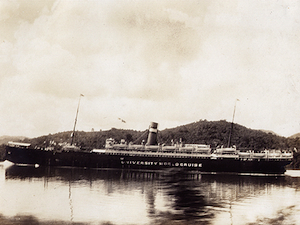
In late September 1926, the SS Ryndam departed Hoboken, New Jersey, on a journey around the world. Dubbed the “Floating University,” she housed about 500 students, representing almost 150 different colleges, and dozens of professors and administrators.  Among the world-class faculty were representatives from Clark University and Williams College, the universities of Michigan, Missouri, New York, Texas, Washington, Turin, and Vienna, and the former governor of Kansas. Almost one third of the students were freshmen, who would earn “[f]ull credit for courses passed” when they returned “to stationary education.” The brainchild of New York University psychology professor James Lough, the charmingly-named “University World Cruise” “visited 35 countries and more than 90 cities,” from Shanghai to Oslo, before returning in May 1927. A precursor of modern study abroad programs, the cruise marked a turning point in the globalization of American education. The goal, as Lough put it, was “to train students to think in world terms.” Within months of its return, educators started formulating a floating high school to supplement the curriculum.

The new Floating University, launched in Fall 2011, does not literally float, but it is no less ambitious. Its signature course, entitled “Great Big Ideas,” purports to offer “the key takeaways of an entire undergraduate education.” In a series of twelve video lectures, students receive “a survey of twelve major fields delivered by their most important thinkers and practitioners.” Topics range from physics to philosophy and feature an all-star cast of instructors from Columbia, Harvard, Yale, and the University of Chicago. Lawrence Summers, the former president of Harvard, offers his thoughts on education. Dean of Yale Admissions Jeffrey Brenzel recommends his “Top 10 Classics” in high definition video “featuring Hollywood production values.” There is even a lecture on investment strategy by superstar hedge fund manager William Ackman. Students at Harvard, Yale, and Bard College can enroll in the course for credit. Others can buy a six-month subscription for the low, low price of $199 (Ackman’s video, “Who Wants to Be a Billionaire?” is available in “enhanced stand-alone format” for $59.99).

Unlike the original Floating University, this most recent iteration has only one course and is not focused on world experience. Instead, it brings the world to you. Although students taking the course for credit meet in person for a weekly seminar, for the most part it is an experiment in structured independent learning. The motive force behind this latest floater is not a professor. Rather, it is real estate mogul Adam Glick. The university is, in fact, a for-profit venture of Glick’s Jack Parker Corporation and Big Think (a website that aggregates what it deems “the most important ideas” of today). While James Lough dreamed of educating global citizens, Glick’s concerns are much more prosaic. “[I]n my business, I was having difficulty hiring generalists,” he said in an interview last year. “Most people had graduated college in the silos of particular majors. They were very, very smart, but didn’t have a lot of perspective.”

I have mixed feelings about Glick’s university. On the one hand, it embodies a collaborative, interdisciplinary spirit that is in great demand these days. Despite the hype, it does make important topics and world-class intellectuals available to almost anyone. Certainly, its broad scope and accessible format will encourage students “to think in world terms.” On the other hand, I am skeptical of running essential public services (such as higher education) as for-profit industries. The inclusion of hedge fund manager Ackman, for example, smacks of a tacky infomercial. There are digital alternatives that offer similar content for no cost whatsoever. Academic Earth, to which Yale contributes, hosts dozens of world-class courses, including a blockbuster series on the Civil War by my adviser. (Learn about the election of 1860 while munching a bowl of popcorn; ponder the shortcomings of the Freedmen’s Bureau while waiting for the bus!) The famous Khan Academy offers a plethora of lectures and tutorials that are like watching a filmed version of Wikipedia. Of course, as every digital humanist knows, “lectures are bullshit.”

Perhaps the most troubling oddity about “Great Big Ideas” is that it has no content in history. Zero. Zilch. Nada. Nothing. Not even close. Is history not a “major field” with “important thinkers?” Even more baffling, history instruction provides exactly the kind of big-picture-oriented, theoretically-grounded, interdisciplinary knowledge to which “Big Ideas” aspires. History is a discipline of disciplines; in their attempts to make sense of the past, historians draw on anthropology, archeology, computer science, demography, economics, film studies, geography, linguistics, literature, musicology, philosophy, physical and natural science, psychology, social theory, and statistics.

History is a vast laboratory of humanity; it illuminates the present by tracing the trajectories of the past. It is, as Robert Penn Warren put it, “always a rebuke to the present.” It tells us that the original Floating University had difficulty raising funds after its maiden voyage, and that it floundered in the wake of the 1929 market crash. If the new Floating University is to avoid a similar fate, it might do with a lesson in history.

A Curious Artifact

Christopher Hitchens died last week. He was an arrogant and abrasive man and a souse. He was also a frightful intellect and a dazzling writer, capable of holding forth on any topic from oral sex to the ten commandments. One obituary writer describes him as “an excitingly dangerous orator.” Although I did not always agree with him, in a weird way, I felt sorry for him.

Some years ago, a friend and I organized a debate between Hitch and political scientist Michael Parenti. It was a learning experience. Even with support from a motley coalition of faculty and student groups, we managed to run a debt. A few weeks later, we graduated. My friend ended up in Venezuela, and I ended up in New Zealand.

When I learned that Hitch had died, I dusted off my DVD of the debate. Unfortunately, the quality was not great. There was a gap where the cameraman switched tapes, and the second tape ran out before the end of the event. So I had to do some creative editing. I swapped out the original soundtrack for a more complete audio recording and used Handbrake to encode to mp4. The original DV tapes from which I had authored the DVD were long gone, so I had to transcode from interlaced mpeg2. I think, in retrospect, it would have been better to convert the VOBs to DV using ffmpegX, edit the DV stream in Final Cut or Quicktime, and then export to mp4. If you ever need to extract and remaster a DVD, this is the method I would recommend. By the time I figured this out, however, I had already invested too much in the direct-to-mp4 method.

Surprisingly, uploading to YouTube was the hardest part. YouTube’s transcoding engine did not care for my spliced edits, which introduced several different tracks and bitrates. The mp4 container is wonderfully robust, capable of supporting a range of tracks and even chapter markers, but it took four days of uploads before I found a way to merge everything together in a way that YouTube would accept. The resulting copy is less than spectacular, but it’s better than nothing. The timecode at the very end is still corrupted somehow. Since mp4 is YouTube’s container of choice, I find it frustrating that they insist on running videos through an additional layer of encoding, over which I have no control. Why not provide their specs and allow users to upload directly to the back end with little or no downsampling?

The video is freely available under a Creative Commons license. A curious historical document, like Hitch, it now belongs to the ages (but definitely not to the angels).

Darwin and the Digital Utopia

Last year, I dwelled briefly on the implications of the Google Books settlement and Dan Cohen’s critique of all pre-Google history as merely “anecdotal.” In the mean time, the “Culturomics” project has burst onto the scene, offering a new way of doing the kind of total history envisioned by Cohen. Culturomics, which uses the Google data set to trace how different words and phrases change over time, has inspired cautious optimism among historians and other groups. I think the project’s claim to represent all of human culture is potentially dangerous, and I will explain why below. But first, to show that I’m not just another luddite crank, I’d like to demonstrate how truly valuable Google Books has been for my work.

Historians, in general, do not like to foreground their methodology. Narrative historians like myself, especially, tend to bury our research strategies and theoretical scaffolding in footnotes and appendices and prospectuses. This helps create a more seamless reading experience, but is not always a good thing. So, in the spirit of open source and to make up for missing the HASTAC Conference this weekend, I will share part of the digital methodology from one of my recent articles.

The article (which you can check out here, if you’re lucky enough to have the right institutional subscription) examines the story of a murder committed by a South American man just south of Chiloé Island in the mid-1700s. I argue that the sole witness to the murder is unreliable and use contextual analysis, manuscripts, printed narratives, and oral histories to back my claim. The murder story appealed to Charles Darwin, who used it at two key moments in his career, and unfortunately it has been mindlessly repeated by historians ever since. Thanks in part to Darwin, the story is now falsely associated with the Yahgan people he encountered on the Cape Horn Archipelago – a group hundreds of miles away and very different from that of the original alleged murderer.

Although I don’t really talk about it in the article, I used anti-plagiarism software (designed to catch student cheats) to track the copying of certain quotes and phrases across texts. The fuzzy logic employed by some of these programs, meant to catch students who alter a word here or a phrase there, is especially helpful in identifying “borrowed” passages in historical documents. I used The Complete Work of Charles Darwin Online to mine for certain phrases. Their large collection of foreign language material is really cool – there is a strong argument to be made for these kinds of subject-specific digital repositories as separate entities from the big universal search engines. I also used Google Ngram and related platforms to chart the use of the murder story by various authors over time.

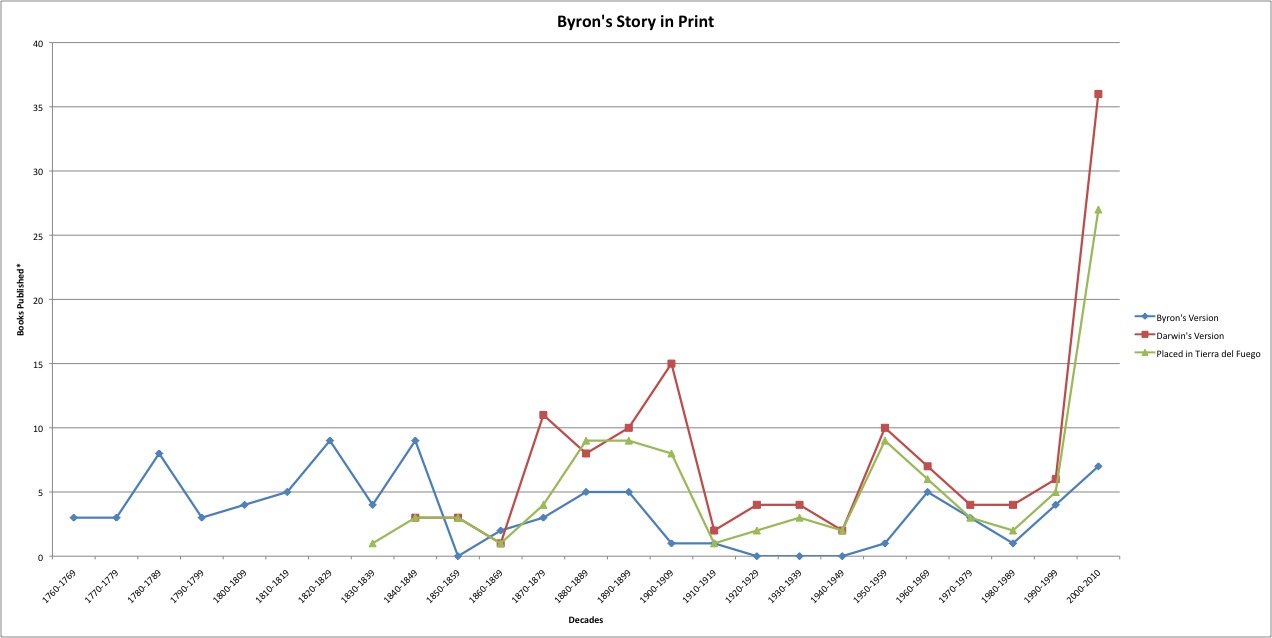
The results (summarized in the chart at left) confirmed my thesis. Use of the original murder story (the blue line) dropped precipitously in the middle of the nineteenth century. Meanwhile, Darwin’s version of the murder (the red line) shot way up. Texts that falsely attribute the murder to the Yahgan people (the green line) correlate more or less directly with the popularization of Darwin’s version of the murder. You can view my original data set here (it’s not the final version, since I stopped using Google Docs at some point, but it gives you the idea).

The graph cannot, however, establish that the murder story is a lie. It can only replicate the lie as it develops over time. Without the broader context established by more traditional historical research, these results would be meaningless. And this brings me to the danger inherent in Culturomics. First, machine-readable texts do not, and will never, represent the totality of the human experience. What about paintings, illustrations, and photographs, statues and figurative art, architecture, music, material culture, and ecology? What about oral history? What about economic, statistical and demographic evidence? Although there are millions upon millions of books, magazines, newspapers, and other printed material, they represent only the visible, privileged, literate tip of a vast store of human culture.

Even more troubling, texts lie. “There is no document of civilization,” said Walter Benjamin, “which is not at the same time a document of barbarism.”  One of the great insights of the “New Social History” was the need to rub documents against the grain. Text mining usually rubs with the grain, merely reproducing the endemic biases and structured incompleteness of the written past. The graph can only replicate the lie.

This is not to say that Culturomics is hopelessly biased and needs to be discarded. On the contrary, it is precisely this kind of utopian enthusiasm – the dream that we can actually develop a more total vision of human culture – that is needed to keep history afloat. Large scale text mining is simply wonderful. Like all great inventions, though, it can be used for good or for ill. And it makes sense, I think, to guard against the naive assumption that all of human culture or history can be reduced to a computational algorithm.

Cross-posted at HASTAC