Brains!

I am teaching African history this semester, which is always a great opportunity to get students thinking internationally and comparatively (of course, I think U.S. history should do the same, but that’s a post for a different day). One of our core texts is Mungo Park’s Travels in the Interior Districts of Africa. First published in London in 1799, Park’s narrative is a classic of world literature and the subject of an equally classic book chapter by Mary Pratt. The archetypical solo European explorer in the African wilderness, or what Pratt calls “the sentimental unhero,” Park was part of a group of international entrepreneurs. Mostly men, they tended to share the same fantasies about “penetrating” the virgin soil of the continental interior. More often than not, they were killed in the attempt (and this forms part of their mystique). In April 1796, Park traveled from the Niger River to the Gambia with a group of 73 merchants, servants, and slaves, and his narrative sheds significant light on the tension between slavery and abolition in this part of the world. He describes the tremendous violence that suffused every aspect of the trade: slaves were whipped, roped, chained, and swapped on a whim. He describes the chaotic scene as the entire coffle itself is nearly captured and enslaved by a rival group. He describes slaves running away and returning, refusing to eat or drink, and forced to march until they collapse. These same slaves give Park water and tend to him when he is sick. It is a truly remarkable, and sometimes downright bizarre snapshot of a particular place and moment.

Doing some research on Park for my class, I was intrigued to learn that he was also a zombie. Returning to Africa in 1805, Park mysteriously disappeared, and the lack of a body or any of his personal effects has fueled speculation ever since. According to this (highly credible) website, locals and other travelers reported zombie-like creatures in the area where he was last seen, “including several white men.” I could not substantiate even a small bit of this story, but it is fun to think about. It tickles me to imagine Mungo Park’s reanimated corpse lurching aimlessly across the African countryside, on a relentless march to nowhere.

However bogus this story, there is a kind of poetic verisimilitude to it. The history of slavery, especially, is rife with zombies. Throughout four centuries of the slave trade, just as European explorers assumed Africans were cannibals, Africans assumed Europeans were terrifying barbarians intent on eating them. Park described the “looks of horror” on West Africans’ faces, as they “repeatedly asked” if he was a devourer of human flesh. The idea was deeply rooted, he observed, “that the whites purchase Negroes for the purpose of devouring them.” Although he doesn’t deal with the undead as such, Vincent Brown argues that the experience of death and rituals of remembrance were central to the lives of enslaved Africans across time and space. The Vodou religion – perhaps the most important influence on the modern zombie myth – was developed by enslaved Africans. The word “Zombi” itself is of African origin. By the end of the eighteenth-century, in the slave society of Saint-Domingue (what is now the Republic of Haiti), zombi was a creole word that evoked fear and trembling, whose meaning implied a “spirit, returning.” By 1872, according to one observer, the word was “not unfrequently heard in the Southern [United] States in nurseries and among the servants.” (I’m sure I’m not the only one on the edge of my seat waiting for Professor Brown to write an article or a monograph on Zombies and Slavery – or a film – the material is out there and this one is ripe for the plucking.)

Zombies seem to be in vogue these days – just add the word to your title and you have the makings of an international bestseller. Fashionably late as usual, even academics are jumping on the zombie bandwagon. Does this say something about our society at this particular moment in time? Anthropologists Jean and John Comaroff point to a growing epidemic of the undead in modern South Africa as one symptom of the seemingly arbitrary disruptions and uncertainties of the global economy. “Zombie tales,” they argue, “dramatize the strangeness” of reality in a rapidly changing world. They are a surreal response to the surreal nature of the modern market, in which wealth seems to be conjured out of thin air and the dispossessed are stripped of any semblance of autonomy or stability. The protagonists of George Romero’s iconic 1978 film Dawn of the Dead literally imprison themselves in a shopping mall. Romero’s 2005 sequel Land of the Dead, in which the undead achieve a rudimentary form of consciousness, is an even more explicit parable about the dangers of inequality, consumerism, and greed.

Is there a connection between the Africans who rendered the slave trader’s effort to commodify them as a form of cannibalism, consuming their flesh and transforming them into a disembodied spirit, and the moviegoer who fears being bitten and transformed into a mindless consumer? Is there something about the digital revolution – the constant recycling, repurposing, mashing up, crowd-sourcing, and homogenizing – that helps us identify with the zombie? Is there something zombie-like in the reanimation of static books and newspapers as interactive, digital editions? Are the homicidal hordes of Black Friday shoppers, stampeding into a store to grab the latest Xbox 360, analogous to the zombie “herds” from The Walking Dead?

Interestingly, Mungo Park was among the first historical subjects to be resurrected from the analog to the digital realm. Way back in 1996, Microsoft established MungoPark.com as a site for “virtual expeditions on the World Wide Web.” The project included a modern retracing, and digital mapping, of Park’s journey through West Africa – a sort of  precursor to the much more complex and sophisticated GIS projects of today. The Microsoft explorers did not encounter any reanimated corpses on their quest, but I like to think that Zombie Mungo Park is out there somewhere, relentlessly on the march.

This post is dedicated to the memory of Cory Smoot.
Your Slavery Footprint

One of the more interesting concepts developed by Karl Marx (himself one of the more interesting characters in the period of history I study) is the notion of commodity fetishism. The details of the theory, as outlined in volume one of Capital, are a bit complex, but they can be summarized relatively easily. When you enter a modern marketplace, say Amazon.com, to purchase a commodity, say that new Kindle you’ve had your eye on, you do not have access to all of the steps that produced that commodity. You do not see what parts make up the Kindle, where they found the raw materials, how the various pieces traveled to the various factories, who hired the workers, who made the screen, who designed the microchips, who assembled the chassis, who coordinated the whole process, etc. You see only an end-product, a commodity, which you acquire by trading another commodity (money). So what looks like a straightforward exchange between two discrete objects of equal value, money for Kindle, is actually an incredibly complex and layered social interaction involving people, material, infrastructure, governments, trade policies, etc. from all corners of the world. When you purchase a product, however, you rarely think about all this. Each step, each transaction in the commodity chain constructs an elaborate, if delicate fantasy. “A commodity,” writes Marx, “is a mysterious thing.”

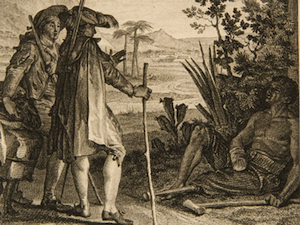
Although I don’t have any direct proof, I suspect that Marx borrowed the idea of commodity fetishism from antislavery activists. At the very least, he absorbed it from the wider Victorian culture of which he was very much a part. Exposing the social reality, the horrific human toll, behind slave-produced commodities is one of the oldest and most important strategies of abolitionist movements. The image at left first appeared in 1787, accompanying a book written by Voltaire three decades earlier. It shows a Surinamese slave, mutilated and broken, lying on the ground near a plantation; the caption reads: “This is the price for the sugar you eat in Europe.” In the original book, published in 1759, the slave castigates les fétiches hollandais (Dutch fetishes) for preaching universal brotherhood while at the same time reducing him to the level of an inhuman object. The slaves who helped produce consumer goods, as Walter Johnson and Edward Baptist establish, were themselves highly fetishized commodities. Abolitionists aggressively promoted free labor sugar and cotton as antidotes to the global trade in human beings. Consumer boycotts and efforts to market “free produce,” as Carol Faulkner and Lawrence Glickman argue, developed alongside opposition to slavery.  The same impulse lives on today in “fair trade” coffee and “made in the USA” stickers. Even the “free trade” fundamentalism that emerged in Victorian England, as Richard Huzzey shows, was deeply rooted in antislavery strategy.

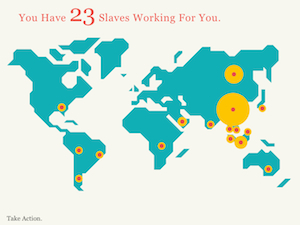
Slavery Footprint, launched last month by a nonprofit group in collaboration with the US State Department, puts a new spin on this old story. The website offers users a simple survey to determine “how many slaves work for you.” The type and amount of clothes you own, the food you consume, and other lifestyle choices all factor into the calculation. In the end, I discovered that I have 23 slaves working for me, which is on the low end of the spectrum. Some estimates place the total number of enslaved individuals as high as 27 million (more than the entire population of the state of Texas). A mobile app linked to the site, called “Made in a Free World,” allows you to monitor progress against human trafficking and earn points by pressuring corporations to clarify their supply chain. Slavery Footprint joins a growing body of digital platforms aimed at demystifying commodities. SlaveFree, developed by the same group, encourages users to post images of their consumer goods accompanied by a demand to liberate them from forced labor. Free2Work allows smartphone users to scan UPC codes to learn how different corporations are implicated in global slavery.  Historians Against Slavery offers a framework for combining scholarship with activism. CNN has launched the Freedom Project. And no doubt there will be many more. Demand on Slavery Footprint was so overwhelming that it crashed the site almost immediately after its launch.

The irony of these initiatives is that they rely on the very same global corporations that they critique. You are not allowed to use the “Made in a Free World” app, for example, unless you agree to join Facebook. The conflict minerals and child workers that help generate touchpads, smartphones, and other low-cost, mass-produced interfaces also help fuel the campaign to eliminate them. Apple made this clear just a few weeks ago, when it quickly yanked a new app called “Phone Story.” The program, which shows some of the brutal child labor that forms part of the commodity chain for the iPhone, is unavailable to Apple customers. “Apps that depict violence or abuse of children,” announced the company, “will be rejected.” Abolition itself is a commodity dependent upon slave labor – inadmissible under its own moral logic.

Earlier abolitionist movements also relied on a consumer revolution, high-speed printing presses, advances in travel and communication, and an increasingly interconnected globe to spread their message. And where slaveholders and their sympathizers influenced those technologies (the national mail, segregated railroad and steamboat cabins, pass systems) abolitionists had a harder time. The present campaigns recall much of this earlier form of activism, usually called “moral suasion.” Yet there are important differences. Slavery is now illegal, at least nominally, in most of the world. Although earlier abolitionists denounced the “unhallowed union” between manufacturers and slaveholders and saw “wealthy capitalists” as impediments to their cause, they did not focus their efforts on improving corporate citizenship. They certainly did not collaborate with the State Department (at least not until the Civil War, when abolitionists participated in the Freedmen’s Bureau and other reconstruction initiatives under Lincoln’s successors).

Like their predecessors, recent campaigns tend to place more emphasis on the purity of the purchaser than on the plight of the victim. “[N]one of us want to wear people’s tragedy,” argues the president of Call + Response, the organization behind Slavery Footprint. “We don’t want to consume their suffering where we have coffee with sugar poured in it.” It is worth remembering that no entrenched system of slavery was ever abolished by boycott or free produce movements. In parts of Africa, the introduction of “legitimate commerce” accompanied an expansion and intensification of enslavement. In most cases, it took a combination of grassroots action, international pressure, and direct government intervention to end slavery; in the United States, it took a revolution. At the same time, consumer awareness campaigns, breaking through all that commodity fetishism, are indispensable to abolition. Ian Baucom calls this “melancholy realism,” but could it also be empathetic or liberatory realism?

In a world where we are even more removed from the source of slave labor than the original abolitionists (who could hop the nearest steamboat south of Jersey), what does it mean to consume someone’s suffering? What does it mean to quantify your contribution to the elimination of forced labor with virtual points?

Cross-posted at HASTAC

GIS in 1861

Enlightenment philosopher Johann Gottfried von Herder claimed that “history is geography set in motion.” An early proponent of a kind of völkisch nationalism, Herder viewed history as a patriotic endeavor, and may not have even used this phrase in his work (I could not find any reference to it prior to 1897. Then again, my 18th-century German is a little rusty). Whatever its origin, I’ve been thinking about this quote a lot lately. My dissertation, which ranges from Nova Scotia to New Orleans, Missouri to England, Hartford to Sierra Leone, is in large part about what I’m calling “the geographies of abolition.” At the same time, I’ve been thinking about incorporating a GIS (Geographic Information Systems) component into the Yale Slavery and Abolition Portal.

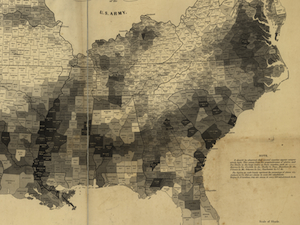
So it was a neat coincidence to run across Susan Schulten’s insightful blog post about the 1861 map of the Slave Population of the Southern States. Part of a series of posts on the unfolding of the Civil War hosted by the New York Times, Schulten’s short essay shows how this single map became a political, social, and military force. Combining census data, geographical surveys, and statistical analysis, the map is a fantastic early example of GIS technology. Lincoln was fascinated with the map, a high resolution copy of which is available courtesy of the Library of Congress, and poured over it in the waning years of the Civil War.

Despite its special role in the history of the Civil War, the 1861 census map was hardly the first to chart the slave population, as well as the growing sectional consciousness, of the United States. Reynolds’s Political Map of the United States drew on the census of 1850 to compare “the principle statistics of the free and slave states” and was used as a propaganda tool by the nascent Republican Party in the election of 1856. This map also featured general statistics on slave ownership and the disproportionate influence of the Slave Power in government (the slave-holding states were colored dark black, a not-so-subtle commentary on their moral and economic standing).  Earlier still was Lewis’ Free Soil, Slavery, and Territorial Map of the United States, published in 1848 (copy available courtesy of Yale’s Map Department). Again, the slave states are painted a dark black and lengthy statistical analysis is employed to mobilize opinion against the Slave Power. In some ways, the Lewis and Reynolds maps are actually more revealing than the 1861 census map, because they focus attention on the uncertain fate of the western territories (a geographic area larger than both free and slave states combined). Certainly both maps were direct models for the more famous 1861 incarnation.

Schulten, an expert on the history of mapping, detailed the statistical and cartographic antecedents for the 1861 census map in a brilliant article in the journal Civil War History. Oddly, it is not cited or even mentioned in her NY Times post. Perhaps the editors thought it was too “scholarly” for a general audience? (I thought it was a damn good read.) In this longer piece, Schulten argues that the widespread use of statistical maps for policy ends was directly stimulated by the antebellum slavery crisis. And, along the way, she makes a convincing case for the role of mapping systems as both reflections of broader historical shifts and key political-historical forces in their own right. This is an insight worth keeping in mind as we barrel head-on through the GIS revolution.

The Age of Wikipedia

I noticed an interesting blurb on the Chronicle of Higher Education today: Professors Shore Up Wikipedia Entries on Public Policy. The short article explains how a small group of professors are working with Wikipedia experts to contribute high-quality content to the famous open-access encyclopedia. The article points out that professors are incorporating the writing and editing of Wiki articles into their course expectations. Although many (if not most) educators ignore Wikipedia in the classroom, there is a legitimate pedagogical advantage to a more direct approach. As one of the participating professors explained: “It truly tests [students’] ability to argue complex issues articulately in the public domain, as well teaching them how to be critical consumers of information.” But perhaps the most interesting part of the article is that the Wikimedia Foundation is actively supporting and facilitating course integration.

Although skepticism of Wikipedia continues to run high, few can doubt its overwhelming public presence. Not only is it driving other, more traditional, encyclopedias out of business, it is often among the top three sources of information on any topic in a standard Google search. Four years ago, the late Roy Rosenzweig published a brilliant article in the Journal of American History, which posed the question: Can History be Open Source? Rosenzweig highlighted the occasional analytical failures and lopsided coverage of Wikipedia – a byproduct of its voluntarist construction – but also pointed to its tremendous benefits for research and teaching. And I think Rosenzweig and his followers are correct to call for greater interaction and engagement with Wiki-style projects rather than pious denouncement (an all-too-common knee-jerk reaction from established academics).

Around the same time as Rosenzweig’s article, philosopher (and Wikipedia co-founder) Larry Sanger launched Citizendium, a more closed, peer-reviewed encyclopedia that has struggled to keep up with its big brother. This new Wikipedia-Academia partnership might be a good compromise between the two systems. Scholarly, professional input could supplement and augment existing material while not shutting out the hordes of amateur enthusiasts who have made the open-source encyclopedia such a popular success. Whatever the case, it is clear that the Wiki is here to stay. It is not difficult to imagine a Wiki article given the same (or even more) weight as a standard reference entry by the hiring and tenure committees of the future. And, certainly, it will continue to play a role in classroom environments, whether we want it to or not.

Open Access Week

This week is the fourth annual Open Access Week, “an opportunity for the academic and research community to continue to learn about the potential benefits of Open Access, to share what they’ve learned with colleagues, and to help inspire wider participation in helping to make Open Access a new norm in scholarship and research.” The week boasts its own website to coordinate events and contributions from around the globe. Although the site itself is a bit schizophrenic, it features some great material and is well worth the time to explore. A short film from the UK about the absurdly repressive practices that block access to film archives struck me as especially sharp and well-done. How much history (not to mention historical consciousness) are we losing because primary sources are locked away in this fashion?

In the spirit of Open Access Week, I thought I would highlight some great Open Access projects at Yale, a few of which have already been featured on this blog. Yale Open Courses is perhaps most conspicuous, offering free access to a range of high quality lectures (more lectures are available as podcasts on the Yale section of iTunes U). Another popular resource are digitization projects, such as the Historical New Haven Digital Collection, which “contains over 500 images of historical New Haven, as well as over 75 documents containing key census information and other data from New Haven over the past 150 years.” The library’s Digital Collections site offers a centralized space for exploring the profusion of digitized objects and documents spread across the university. Although not hosted at Yale, the university contributes material to UNESCO’s World Digital Library, a relatively new and (hopefully) growing clearinghouse for digital material from around the world. Research gateways, such as the Yale Slavery and Abolition Portal and the recently-launched resources module at the Yale Research Initiative on the History of Sexualities, encourage students and researchers from around the world to investigate the vast archival holdings of the University, both analog and digital. And I would be remiss not to mention the Information Society Project at Yale Law School, which sponsors a conference series on “Access to Knowledge” in the digital age.

There is much to be done to promote broader access to and interaction with digital resources. Nevertheless, as the overwhelming international response to Open Access Week demonstrates, this new model of academic practice will be a powerful and important force in our future.