Take a look, it’s in a book…

I want to give a shout-out to Anthologize, a new tool that allows WordPress users (like myself) to organize, edit, and publish blog posts as fully-formed books. A while back, I discussed the increasing significance and sophistication of history blogs. Anthologize now allows historians and other academics to compile, well, anthologies of their best digital scholarship and distribute them in myriad formats. Since even academic blogs contain a wide variety of posts, ranging in quality as well as theme or topic, Anthologize offers a new way to organize and present interesting work that may be scattered or difficult to find online.
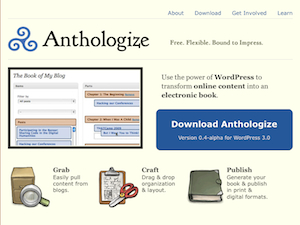
Yale professors who make extensive use of blogs in their courses can use Anthologize to generate thematic collections of student work. Other applications include organizing research material, compiling lecture notes or primary sources, producing a collaborative journal or creative work, and generating exhibition books based on a blog of archive or museum collections.

Impressively, Anthologize was developed, coded, and released in just one week by a team of twelve digital humanists. It is still only an alpha release, and many features do not work as well as one would hope. Some might wonder about the ramifications of taking an inherently dynamic format, with outside user comments, hyperlinks, and media files, and rendering it static. With all the advantages of digital interactivity, hyperlinking, mashups, social networking, etc., this transformation might seem a step back to a more “primitive” medium. Still, I think there is much potential here.
Yale Slavery and Abolition Portal

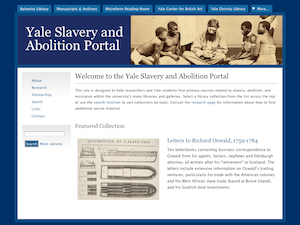
It is my pleasure to announce the launch of the Yale Slavery and Abolition Portal (http://slavery.yale.edu). Sponsored by the Gilder Lehrman Center for the Study of Slavery, Resistance, and Abolition and the Instructional Technology Group, this site is designed to help researchers and Yale students find primary source material related to slavery and its legacies within the university’s many libraries and galleries. Users can browse a small catalog of noteworthy collections, learn how to search for additional material, or explore a growing list of external resources. The portal is still in its early stages, and we welcome input and suggestions from researchers, students, and staff. Future improvements will include an interactive teaching component, dynamic tags, user-submitted material, and more.

Our objective was to create a simple yet robust interface that would be flexible and expandable for use in both classroom and research environments. In keeping with the project’s collaborative nature, faculty, students, and staff will be able to add, edit, or annotate collections without the need for technical expertise. Although this model is far from perfect, it shows great potential. During the design phase, collaborators were given the option of uploading and curating their own content, while others provided suggestions and advice. Archivists, curators, and librarians from almost a dozen different institutions and departments were crucial partners at all stages of the project.

The portal took about one year to complete, from conception to launch, and I think it offers something more than a run-of-the-mill research guide. In addition to archive and rare book blogs (for example, at the Beinecke and Law Library), I think the Slavery Portal is a unique and dynamic tool that will have a deep impact on both research and teaching.

Full disclosure: I am a project manager and the primary web designer for this portal.

Historians and Blogging

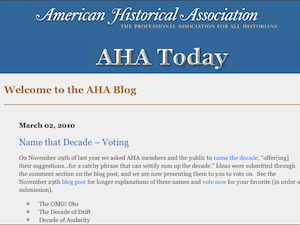
Blogging has become a popular activity for historians and other scholars in recent years. Numerous historians publish personal or group blogs that comment on their work and current trends in the field. Many are both eloquent and entertaining, while some combine analysis, erudition, and creative insight to rival the best “traditional” scholarly work. The History News Network maintains a group blog, called Cliopatria, which aggregates some of the best of recent digital content. But I’d like to draw special attention to the official blog of the American Historical Association (AHA).

As the oldest and largest association of professional historians in the country, the AHA needs no detailed introduction here. For well over a century, the AHA has been a constantly looming presence within the profession. But some might be surprised to learn that its official blog is one of its most lively and informative publications. Entries survey the latest digital trends and articles, summarize AHA professional activities, and advertise fellowship and grant opportunities. Recent posts also take detailed looks at digital resources for subjects like medical history and oral history and offer introductions to major physical archives and repositories. An interesting post from earlier this year, for example, introduces readers to the Special Collections division of the National Agricultural Library.

But don’t take my word for it. Click over and explore this gateway to a vast and verdant world of digital history.

Using Clickers to Enhance Your Teaching

For those not up to date on the latest tech-speak, “clickers” are small hand-held devices that allow students in large lecture classes to respond to a series of multiple-choice questions. Responses are beamed anonymously to the instructor and, in most cases, displayed as a graph or chart through a digital projector.  A recent article in Perspectives on History, the monthly journal of the American Historical Association, provides an excellent review of clicker technology in the history classroom. “A well-planned clicker question,” the author writes, “can be a great way to introduce students to a problem or question that will structure a class session.”

clickersExtremely popular in science and social science classrooms, there are myriad uses of clicker technology in history and the other humanities. I will not summarize the Perspectives article here, though I  encourage you to read it in full if you are interested.

Some faculty use clickers for peer instruction. Others use them for fast, anonymous polling of the entire class – comparing student assumptions before and after a section or course can be quite revealing. Students can also be associated with individual clickers for grading purposes.

The Instructional Technology Group (ITG) manages the use of clickers at Yale. There are about 1,200 clickers available for student checkout at the Bass Library, and support staff are available to help instructors learn and use the technology. ITG hosts an introductory website on the use of clickers. Information about how to incorporate clickers into your teaching can be found there, or you can contact their office directly at: [email protected].  ITG also maintains an informal blog for clicker users at Yale, called the Clicker Clique.

Whither Google Books?

Google’s recent showdown with China has drawn a lot of media attention, but historians and other digital humanists have also been paying closer attention to the search engine giant. Dan Cohen’s talk at the American Historical Association meeting in San Diego this month tackles the question:”Is Google Good for History?” The talk, which is posted in full on Cohen’s blog, answers with a qualified but overwhelmingly positive “yes.”

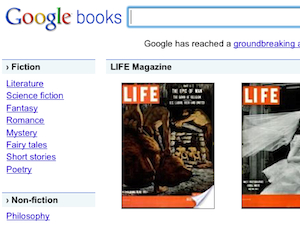
google_booksCohen devotes most of his analysis to the controversial Google Books project. Although seen as a tremendous boon by most researchers in the humanities, the project is far from perfect. In a popular article published in the Chronicle of Higher Education last year, linguist Geoffrey Nunberg argues that Google’s database is not yet the omniscient text-mining tool of which many have been dreaming. Not only is the database incomplete, Nunberg points out, it is riddled with basic factual errors and misinformation. The full title of his article is Google’s Book Search: A Disaster for Scholars. At least one Google employee has written a forceful rejoinder to these charges.

Although he laments the closed, proprietary nature of the Google Books interface, Cohen agrees that detractors are looking a gift horse in the mouth. He writes that his students “regularly…discover new topics to study and write about through searches on Google Books.” Moreover, he argues, large-scale data mining on Google challenges the traditional model of historical research, in which analysis is based on careful extrapolation from a limited number of sources. The old model, which Cohen labels “anecdotal history,” can now be replaced by a more comprehensive method, rooted in thousands of terabytes of digital data. According to Cohen: “our analog, necessarily partial methods have…hidden from us the potential of taking a more comprehensive view, aided by less capricious retrieval mechanisms which, despite what detractors might say, are often more objective than leafing rapidly through paper folios on a time-delimited jaunt to an archive.”

At the end of his piece, Cohen issues a call for historians to push Google in a better direction and for Google to study and adopt some of the strategies and methodologies used by historians. But the debate lingers. Is Cohen right about the stark rift between analog and digital modes of historical research? Do you use Google Books in your research and teaching? If so, how?

UPDATE: I’ve just read a new article by Harvard Law Professor Lawrence Lessig on the recent Google Books settlement. Lessig argues that the terms of the agreement set the stage for “a catastrophic cultural mistake.” The prose is accessible, the argument is lucid, and the critique of the insanity that is current copyright law is frankly, brilliant. This article should be mandatory reading for anyone interested in a career in the humanities.

Another brilliant article on Google Books was published recently by the History News Network. Discussing the French reaction to Google’s project, the author reminds us that the idea of the “information marketplace” is a historical (and political) construction.