The Digital Lincoln

In September, the Journal of American History published a special issue entitled: Abraham Lincoln at 200: History and Historiography. The overall quality of this issue is superb and its format is rather innovative for a mainstream academic journal (a hint of things to come?). Perhaps the most fascinating aspect of this issue is an interpretive website called “Building the Digital Lincoln.” The site consists of a series of links to a wide swath of digital material related to Lincoln and his era. Even those who are not specialists in American history should take a careful look at this site. It is a prime example of the exciting new educational and methodological tools made possible by the digital revolution.
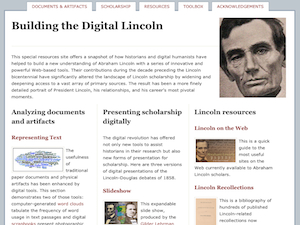
lincoln“Building the Digital Lincoln” is divided into three major parts. “Documents & Artifacts” surveys innovative new ways of collecting, interpreting, and presenting primary source data – from word clouds and timelines to interactive maps and 3D models. “Scholarship” focuses on various ways of presenting historical analysis online. And “Lincoln Resources” provides an overview of the many websites and databases out there devoted to Lincoln studies. Of special interest is its sister site, the House Divided project, based at Dickinson College.
Digital Pedagogy

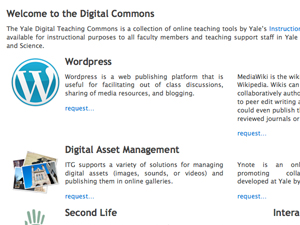
The Teaching Commons gateway, run by Yale’s Instructional Technology Group (ITG), provides a brief overview of the cutting-edge digital tools available to faculty members and staff. Visitors can read about the kinds of technologies in which we specialize and request further information from ITG about how to integrate these tools into their course or research project. While most tools are geared toward classroom teaching, such as the very popular WordPress course blogs, others like Ynote and Custom Online Maps focus on collaborative research and data analysis and have a multitude of applications both within and outside the classroom.

commonsFrom the website:

The Yale Digital Teaching Commons is a collection of online teaching tools by Yale’s Instructional Technology Group. These services are available for instructional purposes to all faculty members and teaching support staff in Yale College and the Graduate School of Arts and Science.

Digital Collections at Yale

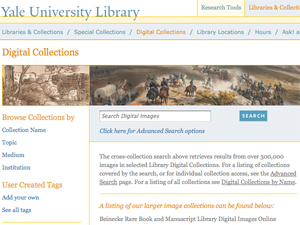
Yale’s Digital Collections search engine is a key resource for innovative research and teaching. The site, which provides a single access point for digitized documents across all university collections, is especially significant for historians. Users can perform a simple keyword search across all collections, or narrow their search by collection or document type. Audio recordings, diaries, drawings, maps, photographs, and scrapbooks are among the primary source materials available on the site. The digital image or file is usually hosted on a separate site associated with its parent library or collection. Clicking the file will take you to its parent page and further descriptive information. Users also have the option to create custom tags and annotations for individual items, which will aid future research.

digital_collThe digital collections available from university libraries are far from comprehensive, of course. It is unclear what criteria are used to determine which primary source materials are digitized and which are ignored, and some collections appear arbitrary or incomplete. So this website is not yet a substitute for more traditional (analog) collections and search strategies. As a supplement to more traditional methods of research and teaching, however, this search engine shows a great deal of promise.

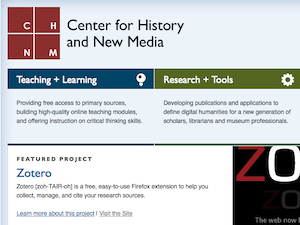
Center for History and New Media

The Center for History and New Media (CHNM) at George Mason University is directed by Dan Cohen, a Yale alum. The CHNM website is another great starting point for thinking about digital history projects. Staff members at the Center have developed a number of interesting and useful tools, including the  Zotero plug-in, which is quickly supplanting EndNote and RefWorks as the standard tool for managing and sharing scholarly citations. They also sponsor a biweekly podcast entitled Digital Campus, which discusses the impact of digital media and technology on research and teaching.

CHNMFrom the CHNM website:

CHNM uses digital media and technology to preserve and present history online, transform scholarship across the humanities, and advance historical education and understanding. Each year CHNM’s many project websites receive over 16 million visitors, and over a million people rely on its digital tools to teach, learn, and conduct research.

Digital Research Tools (DiRT)

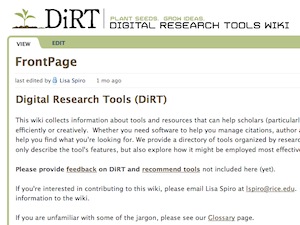
One of the goals of this blog is to provide information and reviews of the latest digital technology for historical research and teaching. So it makes sense to begin with the Digital Research Tools Wiki (DiRT).

DiRTFrom the DiRT website:

This wiki collects information about tools and resources that can help scholars (particularly in the humanities and social sciences) conduct research more efficiently or creatively.  Whether you need software to help you manage citations, author a multimedia work, or analyze texts, Digital Research Tools will help you find what you’re looking for. We provide a directory of tools organized by research activity, as well as reviews of select tools in which we not only describe the tool’s features, but also explore how it might be employed most effectively by researchers.

DiRT provides links for a wide variety of useful programs and projects, including tools to analyze statistics, create dynamic maps, mine data, organize research material, and visualize data. Although hardly comprehensive, it remains a good place to start for any digital history project.